
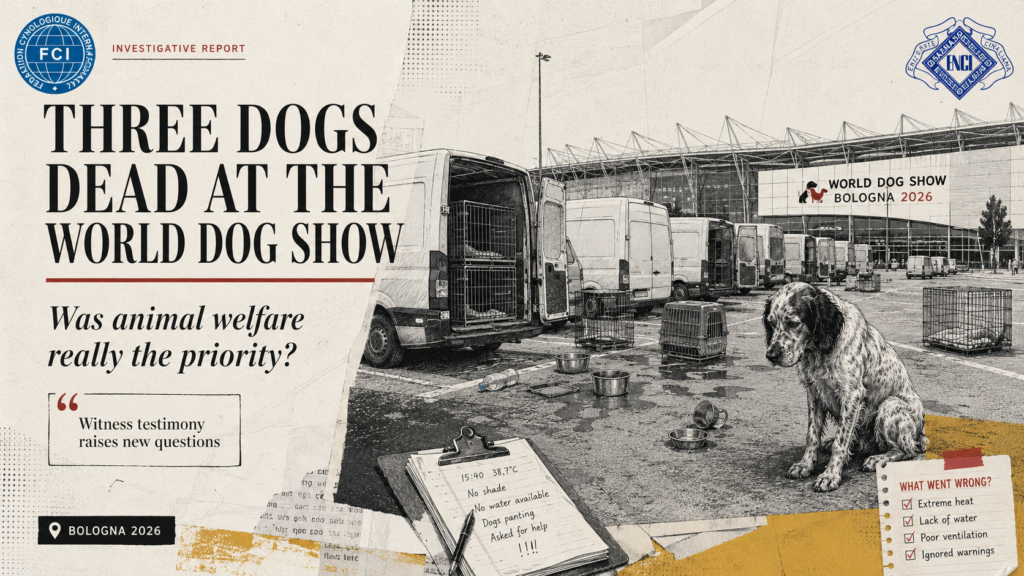
An investigative report into the tragedy, the warnings, the unanswered questions, and the responsibilities that can no longer be ignored

What was supposed to be a celebration of dogs turned into a tragedy.
At the World Dog Show in Bologna, one of the most important international events in the canine world, three dogs died after allegedly being left for hours inside two vans parked in the fairground area. According to BolognaToday, the animals were found in conditions considered incompatible with animal welfare: no access to water, no food, no possibility of getting out, and insufficient ventilation during days of high temperatures.
The dogs were not abandoned in some forgotten place far from the event. They were reportedly inside the perimeter of the fair district, while the show continued around them.
This is the heart of the scandal.
Because when dogs die during a dog show, the issue is no longer just the behaviour of individual exhibitors. The issue becomes the system that allowed it to happen.
The facts reported by BolognaToday
According to the article published by BolognaToday, titled “Tre cani morti nei furgoni alla World Dog Show di Bologna”, the two vans allegedly arrived at the event area at around 6:30 in the morning. They were then parked in the internal courtyard of the Bologna fair district.
Inside the vehicles there were reportedly six dogs.
The owners and exhibitors allegedly left the animals locked inside the vans for hours. When the situation was discovered, one dog was already dead. Three other dogs were found in desperate condition and were immediately taken to a veterinary clinic in Ozzano dell’Emilia. Two of them later died despite the intervention of veterinarians.
The final death toll was devastating: three dogs dead.
The other two animals found in the vans reportedly showed clear signs of dehydration, although their condition was considered less severe.
According to the same source, the three dogs that died were Drahthaars, wire-haired pointing dogs commonly selected for hunting and sporting activities. They were reportedly supposed to participate in the dog show.
Following the first checks, two people — an Italian citizen and a foreign citizen, both described as owners and exhibitors of the animals — were reported to the judicial authorities on suspicion of animal mistreatment.
The investigation will now have to clarify the exact causes of death and determine whether further responsibilities exist.
Source: BolognaToday, “Tre cani morti nei furgoni alla World Dog Show di Bologna”
https://www.bolognatoday.it/cronaca/tre-cani-morti-furgoni-world-dog-show-bologna.html
The witness testimony: did the organization already know?
A testimony from a person who was reportedly present at the World Dog Show raises an even more disturbing question.
According to this witness, the organization was allegedly aware that some exhibitors were keeping dogs inside vans for the entire day, under the scorching June sun. The witness claims that, instead of taking decisive action to remove the animals from the vehicles and place them in covered, safer areas inside the fairground, the response was merely an announcement over the microphone asking people to open the van doors.
If this testimony is confirmed by other sources and by investigators, the implications would be extremely serious.
Because it would mean that the situation was not invisible.
It would mean that the problem was not unknown.
It would mean that the risk was there, in front of everyone, and that the reaction may have been limited to a public announcement instead of immediate enforcement.
Opening van doors is not an animal welfare protocol. It is not a safety plan. It is not prevention. In hot weather, inside a crowded international event, with dogs locked in vehicles for hours, an announcement is not enough.
If the organization knew that dogs were being kept in vans, the question becomes unavoidable:
Why were those dogs not immediately removed from the vehicles?
A dog show cannot ignore what happens outside the ring
Dog shows are built on rules, standards, judging, discipline, presentation, control and image. Every detail of a dog’s appearance is examined. Movement is judged. Coat is judged. Teeth are checked. Structure is evaluated. Handlers are instructed. Rings are organized. Schedules are planned.
But what about the parking areas?
What about the vans?
What about the crates?
What about the dogs waiting for hours before entering the ring?
What about the animals that are not visible to the public, not standing under the lights, not being photographed, not being awarded?
Animal welfare cannot begin and end at the edge of the show ring.
If a dog is protected only while it is being judged, then the system has already failed.
The World Dog Show is not a small local event. It is a massive international event involving thousands of dogs, exhibitors, handlers, breeders, judges, visitors and staff. Such an event cannot rely only on the individual responsibility of exhibitors. It must have strict, active, enforceable welfare controls.
When the weather is hot, the risks are predictable.
When dogs arrive in vans, the risks are predictable.
When exhibitors spend entire days on site, the risks are predictable.
When costs are high and logistics are complicated, the risks are predictable.
And when a risk is predictable, failure to prevent it becomes a responsibility.
The economic pressure nobody wants to talk about
There is another uncomfortable point.
For many exhibitors, attending a major international show is not simply a hobby. It can be a professional obligation, a reputational necessity, a commercial opportunity, or a key moment in a breeding career. Being present at the World Dog Show can matter enormously.
But participation is expensive.
Travel, fuel, accommodation, entry fees, equipment, parking, veterinary documents, handling, grooming, food, logistics and days away from work all create pressure. When costs rise, some exhibitors may try to reduce expenses wherever they can.
That is where dangerous decisions can begin.
If staying inside the fairground in a safer, cooler, organized space requires additional costs, while leaving dogs in vehicles appears cheaper or more practical, the system creates a risk.
This does not excuse anyone who leaves animals in unsafe conditions. It never can.
But it forces us to ask a broader question:
Should safe shelter for dogs at a dog show ever be optional?
If animal welfare is truly the priority, then shaded, ventilated, monitored and safe holding areas should not be a luxury. They should be a basic requirement of the event.
No dog should depend on whether an exhibitor can afford an extra service.
No dog should pay the price of a logistical shortcut.
No dog should die because the system was designed around competition before protection.
The previous warning: the Rende case
This is not the first time the Italian dog show world has faced a tragedy involving dogs left in vehicles.
In 2016, during the 21st dog show in Rende, several dogs reportedly died inside a van, allegedly after a failure of the air-conditioning system. That tragedy should have been a turning point.
It should have led to strict national rules.
It should have produced mandatory parking controls.
It should have made it impossible for dogs to remain unattended in vehicles during canine events.
Yet years later, at the World Dog Show in Bologna, the same terrifying pattern appears again: dogs, vans, heat, waiting, insufficient protection, death.
How many warnings does the system need?
How many dogs must die before prevention becomes mandatory and not optional?
The responsibility of ENCI and the organization
ENCI and the World Dog Show organization now face questions that cannot be answered with generic statements of sorrow.
They must explain what welfare protocols were in place.
They must explain whether parking areas were actively checked.
They must explain whether staff had authority to intervene when dogs were found in vehicles.
They must explain whether exhibitors had access to free or included safe areas for dogs.
They must explain whether announcements were made about dogs in vans.
They must explain whether the organization knew that some dogs were being kept in vehicles for long periods.
They must explain why, if the problem was known, stronger measures were not taken before animals died.
And above all, they must explain what will change immediately.
Because animal welfare is not a slogan to be printed in regulations. It is not a phrase for public relations. It is not something to mention after a tragedy.
Animal welfare is action.
It is prevention.
It is control.
It is enforcement.
It is the courage to stop exhibitors before they make fatal mistakes.
It is the duty to remove animals from danger even when doing so creates inconvenience, conflict or organizational problems.
What must happen now
This case cannot end with two people being reported and everyone else moving on.
If the investigation confirms that dogs were kept in vans for hours under dangerous conditions, then individual responsibility must be pursued fully.
But that is not enough.
The entire structure of dog show safety must be reviewed.
At major canine events, there should be:
- a strict ban on leaving dogs unattended in vehicles;
- active patrols in parking areas;
- immediate removal of animals from unsafe conditions;
- mandatory shaded or climate-controlled holding areas;
- emergency veterinary teams with authority to intervene;
- clear heat protocols based on temperature thresholds;
- public reporting of animal welfare incidents;
- sanctions not only against individual exhibitors, but also against organizational failures.
If a dog show cannot guarantee the safety of dogs outside the ring, then it has no moral authority to judge them inside the ring.
The real question
Three dogs are dead.
Others were reportedly found dehydrated.
Two people have been reported for animal mistreatment.
A witness now claims that the organization may have known dogs were being kept in vans and may have limited itself to a microphone announcement.
If confirmed, that would not be a detail.
It would be a turning point.
Because then the issue would no longer be only: who left the dogs in the vans?
The issue would become:
Who knew?
Who failed to act?
Who allowed the show to continue while animals were at risk?
And most importantly:
Does the official dog world truly put animal welfare first, or only when it is convenient, visible and compatible with the event schedule?
The campaign for information exists for this reason.
Not to create controversy.
Not to attack for the sake of attacking.
Not to exploit tragedy.
But to demand truth, transparency and change.
Because a dog show where dogs die in vans is not just a tragedy.
It is an accusation against an entire system.
And if that system does not change now, then every future statement about animal welfare will sound like an empty promise.