Antitrust law was created for one simple reason: to prevent a single entity from deciding, on its own, the rules, access, economic value, and opportunities within an entire sector. When monopoly power is limited, every private sector improves: competition increases, quality rises, entrenched privileges are reduced, innovation gains space, and alternative models are finally allowed to exist, as long as they are serious, traceable, and responsible.
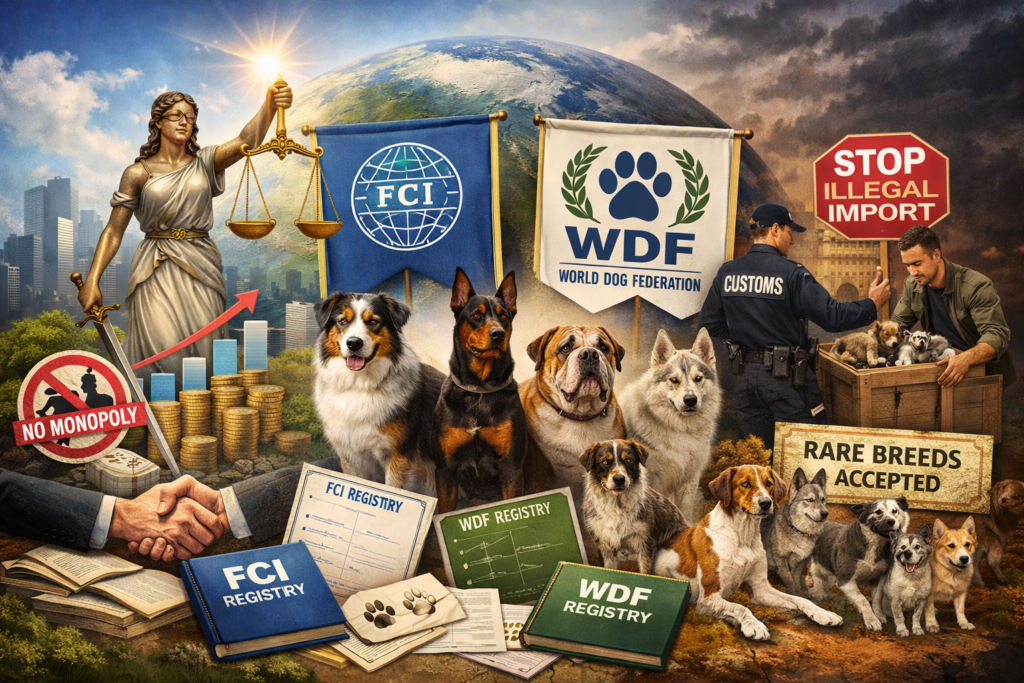
This principle, which applies to every sector, could also bring major benefits to the dog world if applied correctly. Today, one point must be made very clear: asking for plurality does not mean creating confusion. It means recognizing that, alongside the FCI system, alternative organizations such as the WDF World Dog Federation should be allowed to exist, with their own registries, their own standards, their own controls, and equal legal and operational dignity. No one is asking for reciprocal recognition or for registries to be merged. On the contrary: each organization would keep its own records separate, and breeds not recognized by the FCI would finally have their own autonomous registry, without being mixed into the national FCI registries.
The economic benefits could be significant. An open and non-monopolistic system encourages more investment, more qualified breeding, more services, more events, more work for professionals in the sector, more opportunities for honest breeders, and greater freedom of choice for families and enthusiasts. Where there is healthy competition, the real value of the market grows, rather than the value imposed by a single dominant structure.
There would also be major advantages in terms of broader controlled selection. Recognizing alternative registries means expanding the monitored genealogical base, valuing breeding lines that are currently excluded, better documenting origins and characteristics, and building serious pathways for canine populations that are currently left on the margins simply because they do not fit within a single circuit. More real control, not less control.
The fight against illegal importation could also become stronger. When a system excludes entire canine types or serious breeders, the risk is that the market moves into the shadows. By contrast, providing official tools, transparent registries, and lawful alternative channels helps bring hidden activity into the open, makes it easier to trace dogs, verify origins and responsibilities, and truly combat those who trade illegally.
Finally, there is the issue of integrating breeds that are not currently recognized. A modern dog world should not fear diversity, but regulate it through clear rules. If a breed is not recognized by the FCI, that should not mean the absence of rights, the absence of a registry, or the absence of protection. It should only mean that it follows a different path, within a different system, with a distinct identity and equal dignity.
So the real point is not to take anything away from anyone. It is to guarantee equal rights, free competition, transparency, traceability, and respect for all serious canine organizations. An open market does not destroy quality: it selects it better. And a more pluralistic dog world does not weaken existing registries: it stands alongside them, keeps them distinct, and makes the entire sector fairer, stronger, and more modern.